Carlingford is one of the few places in Ireland where you can walk a medieval town plan that is still essentially intact. The whole of it takes about an hour and a half at a gentle pace, and you can do it on your own with this page. Guided walks have traditionally run from the Holy Trinity Heritage Centre in the village — ask there for current times rather than turning up on spec, because they vary with the season.
What follows is a route. It starts and finishes in the village square, and nothing on it is more than ten minutes from anything else.
Start: Holy Trinity Heritage Centre
A medieval church, restored in the early nineteenth century and given over by the Church of Ireland as the village’s heritage centre. Go in first if it is open: twenty minutes here puts the rest of the walk in order, and it is the difference between looking at old stones and understanding what you are looking at. Opening is seasonal.
1. The Tholsel
From the centre, walk to the arch across the street. This is the Tholsel, the last surviving gate of Carlingford’s town walls. The word means toll house, which is what it was; later it was the town gaol. Most people walk under it without looking up. Look up.
2. The Mint
A few steps on, a fortified town house of the fifteenth or sixteenth century, with the best carved limestone windows in the village still in place. Carlingford was granted the right to strike coin in 1467, which is where the name comes from — though it is doubtful the building ever worked as a mint. It is a private building — the outside is the visit.
3. Taaffe’s Castle
On Newry Street, a sixteenth-century fortified merchant’s house built by the Taaffe family, later Earls of Carlingford. Gun loops, a vaulted ground floor and walls thick enough to argue with — a trader who needed all that was doing serious business in a dangerous place. It is a pub now, so you can go inside, and the stonework is right there above the bar. There is no museum, so go for the pint.
4. King John’s Castle
Down towards the water, on the rock that controls the mouth of the lough. Begun around 1190 by Hugh de Lacy, with an enclosed courtyard and towers at the entrance; the eastern half was added in the 1260s. It is called King John’s because John, Richard the Lionheart’s younger brother, is said to have stayed here in 1210 — and you will also see it called Carlingford Castle, which is the same building.
Access to the interior is seasonal — the Carlingford Lough Heritage Trust runs guided tours from March to October, so do not build the walk around getting inside. The outside, and the view from beside it, are the point.
5. The harbour and the marina
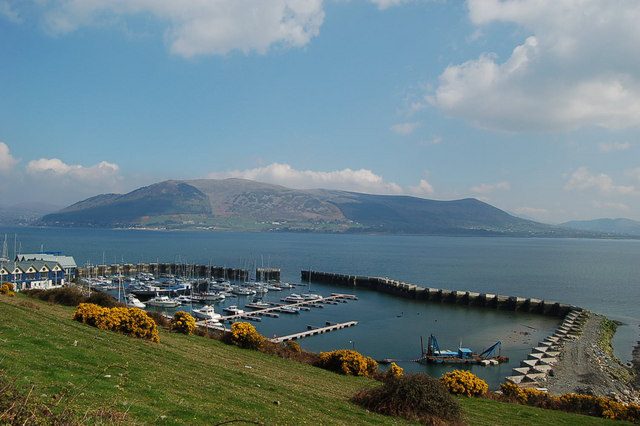
The lanes run down from the old streets to the harbour, which is where the whole village started — Carlingford shipped wine, salt, hides and fish across the Irish Sea for centuries. Carry on round the shore to the marina for the clearest view of the Mourne Mountains you will get without climbing anything. Seals are often on the rocks.
6. The Dominican friary
At the edge of the village, the ruins of a Dominican friary founded in 1305 and dedicated to St Malachy. The chancel and nave survive, divided by a tower, and there is a mill and a pond to the south-east. It was suppressed in the sixteenth century along with the rest of the religious houses and the Dominicans moved on. Most visitors never walk this far, which is a pity — it is the quietest and in some ways the best of it.
The Norse beginning, since you will be told about it
Vikings were working this coast from the end of the eighth century, and the lough — deep, sheltered and pointing inland — was exactly the water they wanted. The name is theirs: Old Norse Kerlingfjörðr, usually rendered as the fjord of the hag. Nothing Norse survives above ground, but the decision about where to put a harbour does, and everything since has been built on it.
The history of Carlingford goes into all of this properly, including the local story of the 236 leprechauns of the Cooley Mountains and their EU-protected habitat.
Practical notes
- Ninety minutes at a gentle pace, less if you do not go out to the friary.
- Cobbles and slopes. Sensible shoes, and it is not an easy route with a wheelchair or a buggy in places.
- Check opening times for the Heritage Centre and the castle before you set out; both are seasonal.
- It is a village. Doing this with a party of twenty means arriving in twos and threes rather than as a coach party, and booking somewhere for lunch afterwards.
Where to stay
The walk starts in the village and Carlingford Heights is half a mile above it — ten to fifteen minutes downhill on foot, a steadier climb back, near enough to walk down and set back enough to be quiet. It is a six-bedroom lodge let as a whole house, sleeping twenty. The gallery shows it room by room and the booking page has the rates and terms.
The top ten attractions covers what is worth doing beyond the old town, and the pubs and restaurants guide sorts out lunch.